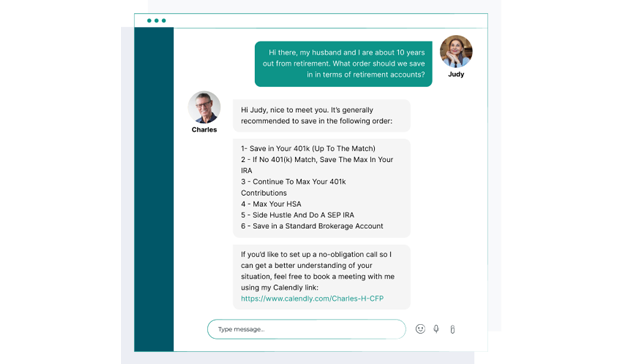

A 401(k) plan is an employer-sponsored retirement savings plan. It allows eligible employees to contribute part of their wages to a retirement account, typically through automatic payroll deductions. The money in the account is typically invested. Over time, those investments may grow through market gains, dividends, and compounding. The name “401(k)” comes from the section of the Internal Revenue Code that created the rules for this type of retirement plan. In everyday language, though, people usually use “401(k)” to mean their workplace retirement account. A 401(k) is different from a regular savings account. It is designed for long-term retirement savings, not short-term spending. That is why the account comes with tax advantages, contribution limits, withdrawal rules, and potential penalties if funds are withdrawn too early. Have questions about 401(k) Plans? Click here. Most 401(k) contributions happen through payroll deductions. You tell your employer what percentage of your paycheck you want to contribute, and the money goes into your 401(k) before it reaches your bank account. For example, if you earn $70,000 per year and contribute 10%, you would contribute $7,000. That money would be spread across your paychecks. Many plans let you choose a percentage, such as 5%, 10%, or 15%. Some plans also allow flat-dollar contributions. The main advantage is automation. You do not need to remember to move money every month. Your retirement savings happen before you can spend the money elsewhere. That can be the difference between good intentions and actual progress. An employer match is money your employer contributes to your 401(k) based on your contributions. For example, your employer might match 50% of your contributions up to 6% of your pay. If you earn $60,000 and contribute 6%, you would put in $3,600. Your employer would add 50% of that amount, or $1,800. This is why many financial advisors encourage workers to contribute at least enough to receive the full employer match. Not doing so may mean leaving money on the table. Employer matching formulas vary. Some are generous. Some are modest. Some employers do not offer a match at all. Still, if your company does provide one, it is one of the biggest benefits of using the plan. A 401(k) is usually invested, not simply held in cash. Your plan may offer options such as stock funds, bond funds, target-date funds, index funds, actively managed mutual funds, stable value funds, or money market funds. You do not get unlimited investment choices. You choose from the menu selected by the plan provider and employer. That can be helpful if the plan has strong, low-cost options. It can be frustrating if the plan has high fees or limited choices. Your investment mix matters. Someone in their 20s may choose a more growth-oriented portfolio because they have decades before retirement. Someone nearing retirement may want a more balanced approach to reduce risk. The right choice depends on your age, goals, risk tolerance, and overall financial situation. A traditional 401(k) allows you to contribute pre-tax dollars. That means your contributions can reduce your taxable income in the year you make them. For example, if you earn $80,000 and contribute $10,000 to a traditional 401(k), your taxable income may be reduced for federal income tax purposes. You do not avoid taxes forever. You generally pay taxes later when you withdraw the money in retirement. This can be useful if you are in a higher tax bracket today and expect to be in a lower tax bracket later. The traditional 401(k) gives you a tax break now. The trade-off is that withdrawals are generally taxable later. A Roth 401(k) works differently. Contributions are made with after-tax dollars, so they do not reduce your taxable income in the year you contribute. The benefit comes later. Qualified withdrawals from a Roth 401(k) may be tax-free in retirement. That can be valuable if your tax rate is higher in the future, if tax laws change, or if you want more tax-free income flexibility later in life. A Roth 401(k) may appeal to younger workers, people in lower tax brackets, or anyone who wants to diversify their future tax situation. A safe harbor 401(k) is designed to help employers meet certain retirement plan rules more easily. In exchange, employers usually must make required contributions for eligible employees. These contributions may be matching or nonelective. Safe harbor plans are especially common among small businesses that want to offer a 401(k) while avoiding some annual nondiscrimination testing issues. These rules are meant to ensure that retirement plans do not unfairly favor owners and highly compensated employees. For workers, a safe harbor plan can be attractive because employer contributions are often required and may vest immediately. Also called an individual 401(k), it is for self-employed individuals or business owners with no employees other than a spouse. This type of plan can be powerful because the business owner may be able to contribute as both the employee and the employer. That can allow higher retirement savings than some other self-employed retirement options, depending on income and tax situation. A solo 401(k) is often used by freelancers, consultants, independent contractors, and small business owners who want to save aggressively for retirement. The IRS sets annual limits on how much employees can contribute to 401(k) plans. For 2026, the employee elective deferral limit is $24,500. This is the amount an employee can contribute from their own paycheck to a 401(k), 403(b), most 457 plans, or the federal Thrift Savings Plan. Workers age 50 or older may also be eligible for catch-up contributions. For 2026, the standard catch-up contribution limit for many 401(k) participants age 50 and older is $8,000. There is also a higher catch-up contribution limit for certain workers ages 60 to 63. For 2026, that enhanced catch-up limit can be up to $11,250, if the plan allows it. There is also an overall limit on the total annual additions to a 401(k), including employee contributions, employer contributions, and certain other amounts. For 2026, that overall defined contribution limit is $72,000, or higher when eligible catch-up contributions apply. These limits matter because they affect how much tax-advantaged retirement savings you can build each year. Most workers will not max out their 401(k). That is okay. The first goal is usually consistency. Then, over time, you can raise your contribution rate as your income grows. With a traditional 401(k), you may reduce your taxable income today. Your money then grows tax-deferred, meaning you do not pay taxes on gains, dividends, or interest every year inside the account. Instead, you generally pay taxes when you withdraw money later. With a Roth 401(k), you pay taxes before contributing, but qualified withdrawals may be tax-free in retirement. Both options can be valuable. The best choice depends on whether you would rather receive a tax advantage now or later. If your employer matches contributions, that is extra money going into your retirement account. It can dramatically improve your savings rate. Suppose you contribute 6% of your pay and your employer adds another 3%. Your total retirement savings rate becomes 9% before investment growth. That is a major difference over decades. Even if you cannot save a large amount, contributing enough to get the full match is often a smart first milestone. A 401(k) makes saving easier because contributions come directly from your paycheck. That matters more than people realize. Many people plan to save whatever is left at the end of the month. But by then, bills, groceries, subscriptions, emergencies, and impulse purchases often eat up the money. A 401(k) reverses the order. You save first. Then you spend what remains. This simple structure can build discipline without requiring constant effort. 401(k) plans generally have much higher contribution limits than IRAs. That makes them especially useful for people who want to save more for retirement, reduce taxable income through traditional contributions, or build a larger long-term investment portfolio. An IRA can still be useful, especially because it may offer more investment flexibility. But for high savers, a 401(k) often provides more room. Unlike an IRA or brokerage account, a 401(k) usually limits you to the investment options inside your employer’s plan. Some plans offer excellent low-cost index funds, diversified target-date funds, and strong bond options. Others do not. A weak plan may have expensive funds, confusing options, or limited diversification. That does not mean you should ignore the plan entirely, especially if there is an employer match. But it does mean you should review the investment menu instead of blindly accepting the default. A 401(k) is designed for retirement. If you withdraw money too early, you may owe income taxes and a 10% early withdrawal penalty unless an exception applies. That can make early withdrawals costly. The bigger cost, though, may be lost compounding. Money removed from your 401(k) is no longer invested for your future. A withdrawal today can become a much larger lost balance decades later. That is why a 401(k) should not usually be treated like an emergency fund. Traditional 401(k) accounts are generally subject to required minimum distributions (RMDs). An RMD is the minimum amount you must withdraw each year once you reach the applicable age under IRS rules. The government requires these withdrawals because traditional 401(k) contributions received tax advantages, and the IRS eventually wants the income taxed. RMDs can affect retirement tax planning, especially for people with large retirement account balances. These may include administrative fees, recordkeeping fees, fund expense ratios, advisory fees, or other plan-related costs. Fees matter because they reduce your investment returns. A small fee difference may not seem important in one year. Over 20 or 30 years, it can have a meaningful impact. This does not mean you need to obsess over every expense. But you should know whether your plan has low-cost options and whether you are using them wisely. Your time horizon is how long you have before you need the money. If retirement is decades away, you may be able to take more market risk because you have time to recover from downturns. If retirement is close, you may want a more balanced portfolio to reduce the impact of market volatility. Risk tolerance is your ability and willingness to handle market swings. Some investors can stay calm when the market drops. Others panic and sell. The right investment mix should be aggressive enough to grow but not so aggressive that you abandon it during downturns. A good plan that you can stick with is usually better than a theoretically perfect plan that causes you to panic. Diversification means spreading your money across different types of investments. Instead of putting everything into one company, sector, or asset class, you spread risk across stocks, bonds, and other funds. Many 401(k) plans offer target-date funds, which automatically adjust the investment mix as you get closer to retirement. These can be useful for people who want a simple, all-in-one option. Look at fund expense ratios and plan costs. Lower fees do not guarantee better performance, but high fees create a hurdle. If two funds provide similar exposure, the lower-cost option may be more attractive. For many workers, a 401(k) is worth it, especially if the employer offers a match. The combination of tax advantages, automatic payroll deductions, employer contributions, and long-term investment growth can make a 401(k) one of the strongest retirement savings tools available. That does not mean every 401(k) is perfect. Some plans have high fees. Some have weak investment options. Some workers may need to balance retirement saving with debt repayment, emergency savings, or other financial goals. Still, for most employees, a 401(k) deserves serious attention. At minimum, it is often wise to contribute enough to capture the full employer match. From there, you can decide whether to increase contributions, add an IRA, use a Roth option, or build other investments outside the plan. A 401(k) plan is a workplace retirement account that helps employees save and invest for the future. It can offer tax advantages, automatic payroll contributions, employer matching, and higher contribution limits than many other retirement accounts. The best way to use a 401(k) is to treat it as long-term money. Start by understanding your employer match. Choose between traditional and Roth contributions based on your tax situation. Review your investment options. Watch the fees. Avoid unnecessary withdrawals. Increase your savings rate over time. A 401(k) will not build retirement security by itself. But used wisely, it can become one of the most important financial tools you have.What Is a 401(k) Plan?
How Does a 401(k) Plan Work?
Payroll Contributions
Employer Matching Contributions
Investment Options
Types of 401(k) Plans
Traditional 401(k)
Roth 401(k)
Safe Harbor 401(k)
Solo 401(k)
401(k) Contribution Limits
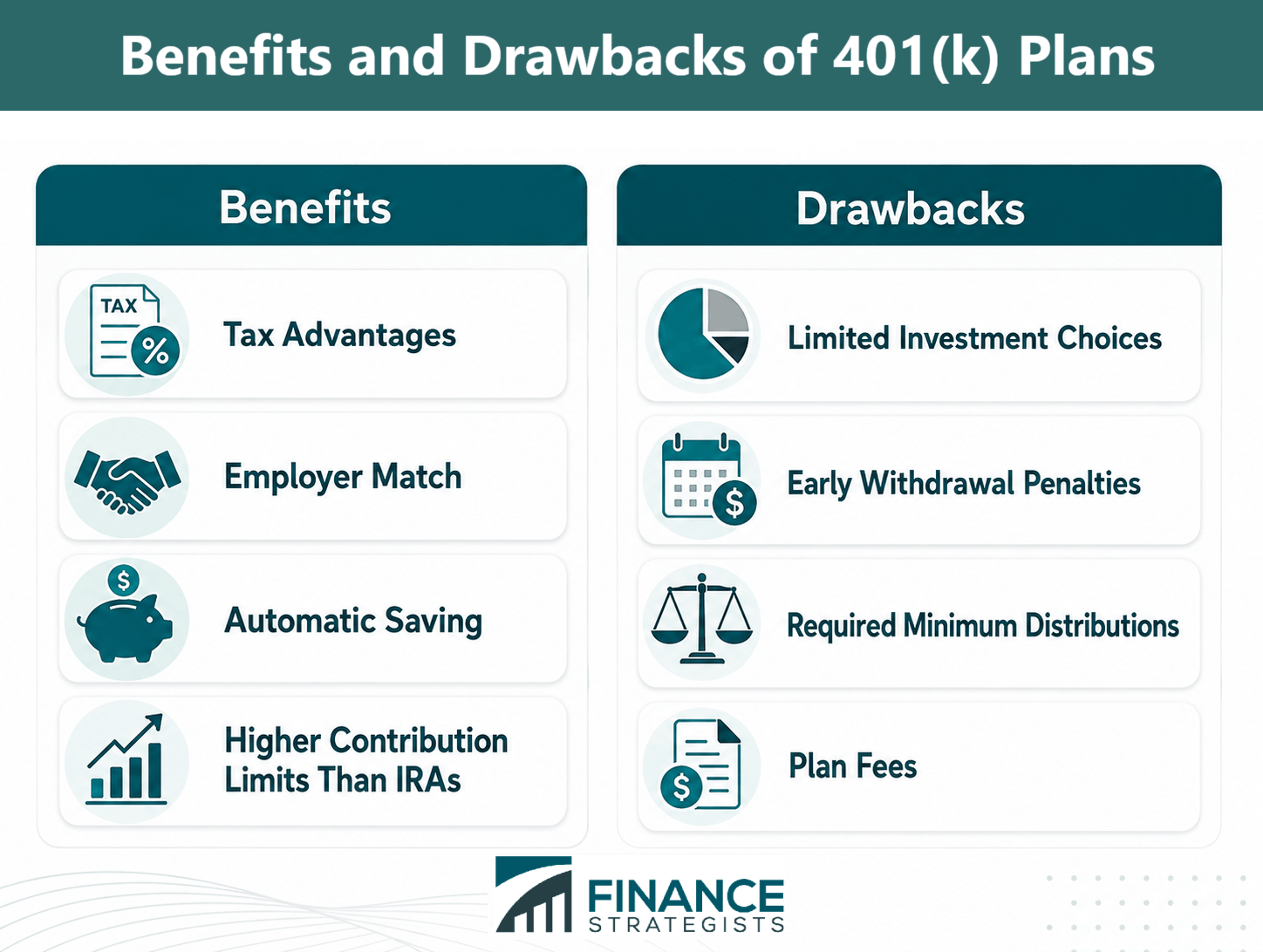
Benefits of a 401(k) Plan
Tax Advantages
Employer Match
Automatic Saving
Higher Contribution Limits Than IRAs
Drawbacks of a 401(k) Plan
Limited Investment Choices
Early Withdrawal Penalties
Required Minimum Distributions
Plan Fees
Considerations When Choosing 401(k) Investments
Time Horizon
Risk Tolerance
Diversification
Fees
Is a 401(k) Plan Worth It?
Bottom Line
401(k) Plan FAQs
You can usually leave it with your former employer, roll it into a new employer’s 401(k), roll it into an IRA, or cash it out. Rolling it over is often better than cashing out because it may avoid taxes, penalties, and lost retirement growth.
Yes, a 401(k) can still be worth using without an employer match because it offers tax advantages, automatic payroll contributions, and high contribution limits. However, you may also want to compare it with an IRA if your plan has high fees or limited investment options.
A 401(k) often has higher contribution limits and may include an employer match, while an IRA usually offers more investment flexibility. Many people use both as part of their retirement strategy.
Yes. Since 401(k) funds are usually invested in stocks, bonds, or mutual funds, the account value can rise or fall based on market performance.
You can generally withdraw from a 401(k) without the 10% early withdrawal penalty starting at age 59½. Some exceptions may apply earlier, depending on your plan and circumstances.
True Tamplin is a published author, public speaker, CEO of UpDigital, and founder of Finance Strategists.
True is a Certified Educator in Personal Finance (CEPF®), author of The Handy Financial Ratios Guide, a member of the Society for Advancing Business Editing and Writing, contributes to his financial education site, Finance Strategists, and has spoken to various financial communities such as the CFA Institute, as well as university students like his Alma mater, Biola University, where he received a bachelor of science in business and data analytics.
To learn more about True, visit his personal website or view his author profiles on Amazon, Nasdaq and Forbes.